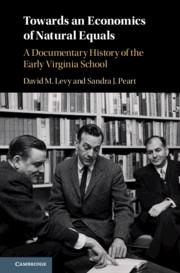
The Virginia School's economics of natural equals makes consent critical for policy. Democracy is understood as government by discussion, not majority rule. The claim of efficiency unsupported by consent, as common in orthodox economics, appeals to social hierarchy. Politics becomes an act of exchange among equals where the economist is only entitled to offer advice to citizens, not to dictators. The foundation of natural equality and consent explains the common themes of James Buchanan and John Rawls as well as Ronald Coase and the Fabian socialists. What orthodox economics treats as efficient racial discrimination violates the fair chance entitlement to which people consent in a market economy. The importance of replication stressed by Gordon Tullock, developing themes from Karl Popper, is another expression of natural equality since the foresight of replication induces care into research. The publication of previously unpublished correspondence and documentation allows the reader to judge recent controversy.
Explores the Virginal School of Political Economy, which has been largely marginalized in the existing scholarship on public choice theory
Separates the Virginia School from mainstream economics and from the Chicago School, with which it is often identified
Examines previously unpublished texts and archival finds that help to illuminate crucial moments in the history of the Virginia School
1. Why the Virginia School of Political Economy matters
2. James Buchanan and the return to an economics of natural equals
3. 'Almost wholly negative': an early reaction to the Virginia School
4. 'The economics of Universal Education' and after: from Friedman to Rawls
5. Virginia political economy and public choice economics
6. The individuals and their connections
7. The role of the Earhart Foundation in the Early Virginia School
8. The early Virginia School and the anti-democratic right
9. Neoliberalism, the Virginia School, and the Geldard Report
10. Conclusion: should the Virginia School be restored?