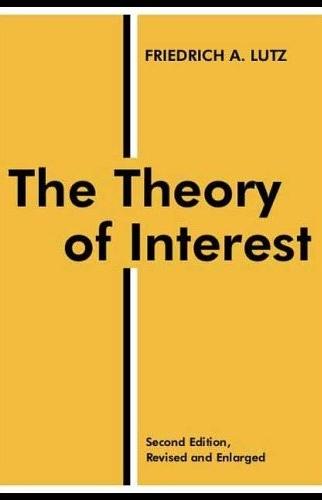
This book contains a critical analysis of the main theories of interest which have been published since Bohm-Bawerk. The last part of the book gives an account of the author's own theory; and how it fits into the Austrian School of Economics. The first part, which deals with the history of doctrines, discusses the theories of Bohm-Bawerk, Wicksell, Akerman, and Hayek, authors who proceed from the assumption of stationary state. The second group of authors consists of Walras, Irving Fisher, and F. H. Knight, who assume a progressive economy in which net saving and investment occur. The third group of authors are those who stress the monetary factor. The central figure of this part is Keynes; but other authors, among them Patinkin, are also dealt with. The theories on the term structure of interest rates are discussed in the last part of the history of doctrines. The author's own theory deals with the problem of the interest rate first in terms of partial equilibrium analysis, whereby particular attention is paid to the influence of the banking system on the structure of interest rates.
In the final chapter the author proceeds to expound the interest theory in the framework of general equilibrium analysis. A mathematical appendix concludes this book; adding greatly to the analytical bases of this school of thought.