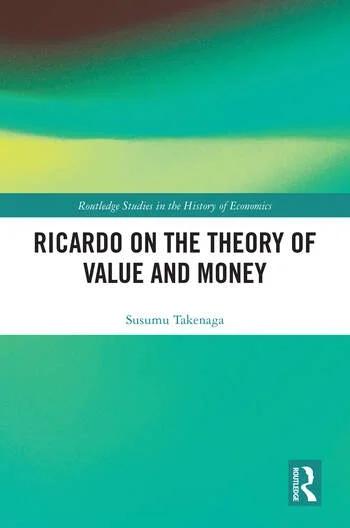
This book is a renovative research work on Ricardos theory of value and of money, achieved through analysis of Ricardos original writings, made available in Sraffas Works.
Takenaga argues that Ricardos economic theory should be understood as a cost theory of value. He begins by re-reading the first chapter of Ricardos Principles, focusing on the chapters theoretical structure and definition of labour. He then extends Ricardos characterisation of the theory of value by situating it in the context of debates with other contemporary economists, namely Torrens and McCulloch. In the third chapter, he argues that Ricardos theory of money is not a quantity theory, and according to him the causal relation between moneys value and its quantity runs from the former to the latter. In the fourth and fifth chapters, he discusses Ricardos plans to reform the English monetary regime of his time. He closes the book with examination on a particular aspect of Ricardo's theory of money: his view on the relation between monetary issue and economic dynamics.
Providing new insights into essential aspects of Ricardos economic theory, as well as into the history of economic thought, this book will appeal to economic researchers, particularly those studying the classical English economists.
Contents
Introduction
1. Structure of David Ricardos theory of value
2. A characterisation of Ricardos theory of value
3. The value of money: labour value theory and quantity theory in Ricardos economic theory
4. Ricardos plans for the reform of the monetary regime
5. Peels Act of 1819 and subsequent changes in monetary circulation
6. An aspect of Ricardos theory of money: monetary issue and economic dynamics
References
Index



 (0 Comentarios)