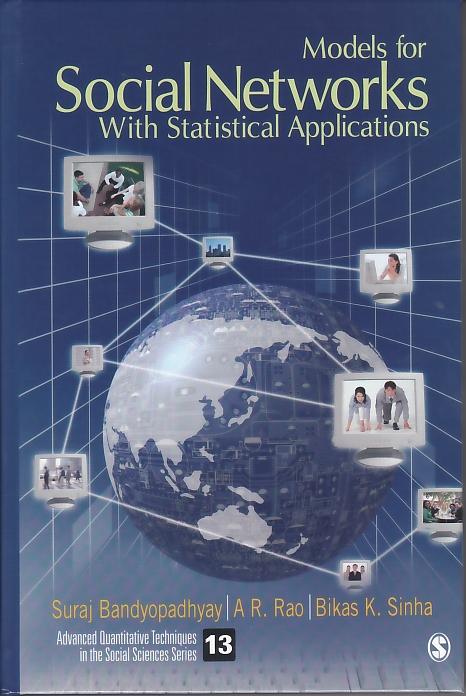
The study of social networks is a new but fast widening multidisciplinary area involving social, mathematical, statistical and computer sciences for application in diverse social environments; in the latter sciences, and specially for the field of Economics. It has its own parameters and methodological tools. In "Models for Social Networks with Statistical Applications", the authors show how graph-theoretic and statistical techniques can be used to study some important parameters of global social networks and illustrate their use in social science studies with some examples in real life survey data.
About the Authors
Preface
Chapter 1 Introduction to Social Network Analysis 1
1.1 Introduction 1
1.2 Concept of a Social Network 1
1.3 Social Network Analysis 4
1.4 Preliminaries 6
1.5 A Few Basic Parameters 10
1.6 A Comparative Study of the Social Networks of a Village at Two Time Periods 14
References 27
Chapter 2 Introduction to Digraphs 31
2.1 Introduction 31
2.2 A Few Basic Definitions 33
2.3 Subdigraph, Converse, and Complement 33
2.4 Null Digraph and Complete Digraph 34
2.5 Symmetry in a Digraph 35
2.6 Out-Degrees and In-Degrees 36
2.7 Connectedness and Components 38
2.8 Distance Between Vertices 42
2.9 Undirected Graphs 44
2.10 Cliques and Independent Sets 45
2.11 Centrality, Radius, and Diameter 47
2.12 Isomorphism 48
2.13 Multidigraphs 49
References 51
Chapter 3 Graph-Theoretic and Statistical Models 53
3.1 Introduction 53
3.2 Models Fixing the Total Number of Vertices 57