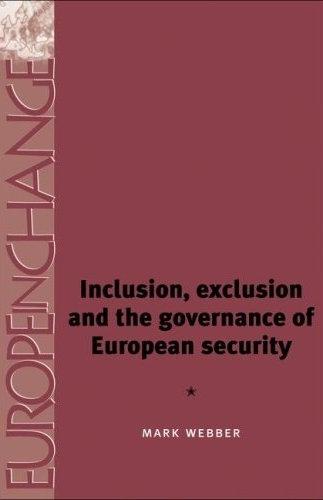
How inclusive are NATO and the EU? The enlargement of both organisations seems, on the one hand, to give some substance to the vision of a 'Europe whole and free' articulated at the Cold War's end. Yet more recently enlargement's limits have increasingly come to be recognised, bringing with it an important debate on the balance to be struck between inclusion and exclusion. This book examines that sometimes awkward balance. Its analytical starting point is the characterisation of much of Europe as a security community overlain, in turn, by a system of security governance. The boundary of this system is neither clear nor fixed, but a dynamic of inclusion and exclusion can be said to exist by reference to its most concrete expression: that of institutional enlargement. On this basis, the book offers an elaboration of the concept of security governance itself, complemented by a historical survey of the Cold War and its end, the post-Cold War development of NATO and the EU, and case studies of two important 'excluded' states - Russia and Turkey. Mark Webber offers a lucid and rigorous theoretical framework as well as a broad-ranging empirical analysis of Europe's security relations. He also addresses key questions relating to Europe's borders, identity and order. This book is an important addition to the literature and will be of interest to specialists and students in the fields of International Relations, Political Science and European Studies.



 (0 Comentarios)