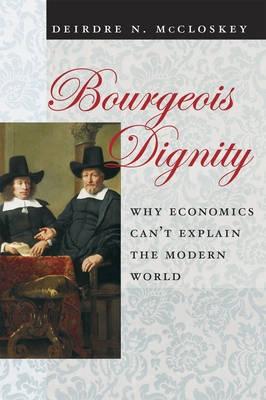
The big economic story of our times is not the Great Recession. It is how China and India began to embrace neoliberal ideas of economics and attributed a sense of dignity and liberty to the bourgeoisie they had denied for so long. The result was an explosion in economic growth and proof that economic change depends less on foreign trade, investment, or material causes, and a whole lot more on ideas and what people believe. Or so says Deirdre N. McCloskey in "Bourgeois Dignity", a fiercely contrarian history that wages a similar argument about economics in the West. Here she turns her attention to seventeenth- and eighteenth-century Europe to reconsider the birth of the Industrial Revolution and the rise of capitalism. According to McCloskey, our modern world was not the product of new markets, but rather the result of shifting opinions about them. An utterly fascinating sequel to her critically acclaimed book "The Bourgeois Virtues", "Bourgeois Dignity" is a feast of intellectual riches from one of our most spirited and ambitious historians.
Preface and Acknowledgments
1 The Modern World Was an Economic Tide, But Did Not Have Economic Causes 1
2 Liberal Ideas Caused the Innovation 10
3 And a New Rhetoric Protected the Ideas 20
4 Many Other Plausible Stories Don't Work Very Well 31
5 The Correct Story Praises "Capitalism" 40
6 Modern Growth Was a Factor of at Least Sixteen 48
7 Increasing Scope, Not Pot-of-Pleasure "Happiness," Is What Mattered 60
8 And the Poor Won 70
9 Creative Destruction Can Be Justified Therefore on Utilitarian Grounds 78
10 British Economists Did Not Recognize the Tide 86
11 But the Figures Tell 93
12 Britain's (and Europe's) Lead Was an Episode 101
13 And Followers Could Leap over Stages 113
14 The Tide Didn't Happen because of Thrift 125
15 Capital Fundamentalism Is Wrong 133
16 A Rise of Greed or of a Protestant Ethic Didn't Happen 140
17 "Endless" Accumulation Does Not Typify the Modern World 146
18 Nor Was the Cause Original Accumulation or a Sin of Expropriation 153
19 Nor Was It Accumulation of Human Capital, Until Lately 161
20 Transport or Other Domestic Reshufflings Didn't Cause It 168
21 Nor Geography, nor Natural Resources 178
22 Not Even Coal 186
23 Foreign Trade Was Not the Cause, Though World Prices Were a Context



 (0 Comentarios)