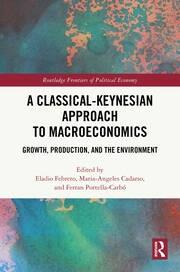
Presenting a robust alternative to mainstream economics, this book outlines a coherent Classical-Keynesian approach to economics - one grounded in the Classical theory of value, the Keynesian principle of effective demand, and the post-Keynesian perspective on money and finance.
The chapters from an international cast of leading authors are arranged around five key topics: the Classical theory of production, prices, and income distribution; the Keynesian principle of effective demand and the supermultiplier; the Keynesian approach to monetary macroeconomics; Classical and Keynesian approaches to the history of economic thought; and input-output analysis of structural change and environmental issues. The chapters explore the dynamics of an advanced market economy, understood as a process organised according to the sequence: finance-production-distribution-spending and accumulation. It is demonstrated that in this process the economy does not gravitate around a full-employment position, that the level of activity, the composition of output, and employment are driven by growth engines located in the autonomous demand connected to output through the supermultiplier, and that money is not neutral and the growth engines require sustainable funding.
This book will be essential reading for researchers in political economy, history of economic thought, economic theory, heterodox economics, and alternatives to the mainstream.
List of figures
List of tables
About the editors
List of contributors
Introduction
Eladio Febrero, Maria-Angeles Cadarso, Ferran Portella-Carbó
PART I: Classical theory of production
1. The aggregate production function: a consideration of some existential problems
Jesus Felipe, John S.L. McCombie
2. On the meaning of sectoral real value added. A Sraffian view
Eladio Febrero
3. Are output proportions close to the Perron-Frobenius eigenvector proportions? Evidence from the Spanish wage-goods baskets (2010-2023)
Jacobo Ferrer, Luis Daniel Torres-González
PART II: The Keynesian principle of effective demand and the Supermultiplier
4. Autonomous demand-led growth and the Supermultiplier: the theory, the model, and some clarification
Franklin Serrano, Ricardo Summa, Fabio Freitas
5. Permanent demand, instability, and growth: Óscar Dejuáns contribution to post-Keynesian economics
José A. Pérez-Montiel, Riccardo Pariboni
6. European fiscal rules, demand-led growth, and the Supermultiplier
Jorge Uxó, Elena Segarra
7. Financial constraints and the Supermultiplier: a Stock-Flow Consistent approach
Ramon Boixadera, Ferran Portella-Carbó
PART III: Monetary macroeconomics
8. The ECBs monetary policy from 2007 to 2018: a long and turbulent decade
Sergio Cesaratto
9. Aggregate demand deficiencies, functional finance, and the neutral interest rate
Alfonso Palacio-Vera
10. Bank accounting, transparency, and financial stability: lessons from the expected credit loss model
Daniel Dejuan-Bitria
11. Financial accumulation in a financialised economy: lessons from Spain
Daniel Feliciano, Jesus Ferreiro, Carlos J. Rodriguez-Fuentes
PART IV: History of economic thought and methodological issues
12. The legacy of Pierangelo Garegnani. A re-assessment of some debated issues
Maria Cristina Marcuzzo, Antonella Palumbo
13. Adam Smiths System of Natural Liberty: the gravitational force of 'morally restrained self-interest'
Fabio Monsalve
14. Revisiting Sraffa from an Ecological economics perspective
Jordi Roca Jusmet
PART V: Environmental and structural input-output analysis
15. How much would the Kyoto Protocol have cost households?
Erik Dietzenbacher, Mònica Serrano
16. Choice of techniques for minimising greenhouse gas emissions
Eduardo Moreno-Reyes, Martín Puchet-Anyul, Pablo Ruiz-Nápoles
17. Scenarios of carbon emissions savings potential from differences in emissions intensities
Maria-Angeles Cadarso, Luis A. López, Nuria Gómez, Carmen Córcoles, Cristian Soria, Daniel Molina
18. Input-output techniques as a key methodology for firm-level carbon footprint calculation: The case of an academic event
Ángela García-Alaminos, Jorge Zafrilla, Marina Sánchez-Serrano, María-Ángeles Tobarra, Mateo Ortiz, Guadalupe Arce
19. Understanding global income inequality (1995-2020) through input-output analysis and vertical integration
Rosa Duarte, Adrián Espinosa-Gracia, Sofía Jiménez, Julio Sánchez-Chóliz
Index



 (0 Comentarios)